
- Datakom solutions

Worry Free IT
We manage your daily IT operations so your team stops firefighting issues.
Security Pro
24/7 endpoint protection that blocks advanced threats before they strike.
Security Operation Center (SOC)
Detect and stop threats before they turn into a business crisis
Tiki-Taka PAY
Process transactions instantly with a secure, glitch-free gateway.
HITSM platform
Centralize all your IT assets, tickets, and vendors in one single dashboard.
AI Engineers
Deploy expert engineering squads to scope, build, and ship your AI projects.
Infrastructure Solutions
Cybersecurity Solutions
AI Solutions
Worry Free IT: Security Pro
We manage your daily IT operations so your team stops firefighting issues.
Security Operation Center (SOC)
Detect and stop threats before they turn into a business crisis
Tiki-Taka PAY
Process transactions instantly with a secure, glitch-free gateway.
AI Engineers
Deploy expert engineering squads to scope, build, and ship your AI projects.
Infrastructure Solutions
Cybersecurity Solutions
AI Solutions
Worry Free IT
We manage your daily IT operations so your team stops firefighting issues.
Security Pro
24/7 endpoint protection that blocks advanced threats before they strike.
Security Operation Center (SOC)
Detect and stop threats before they turn into a business crisis
Tiki-Taka PAY
Process transactions instantly with a secure, glitch-free gateway.
AI Engineers
Deploy expert engineering squads to scope, build, and ship your AI projects.
Infrastructure Solutions
Cybersecurity Solutions
AI Solutions
- Partner solutions
- About us
- About Datakom
We don’t wait. We explore, experiment, and introduce new products and technologies early — so you get ahead, not catch up.
- Contact sales
- For clients

























29.09.2026
The Recovery Mistakes That Cost Small Businesses the Most
The best football teams don’t just prepare for the game. They prepare for the moment the game plan falls apart. An ejection, an injury, a missed assignment or a controversial call can change everything in seconds.
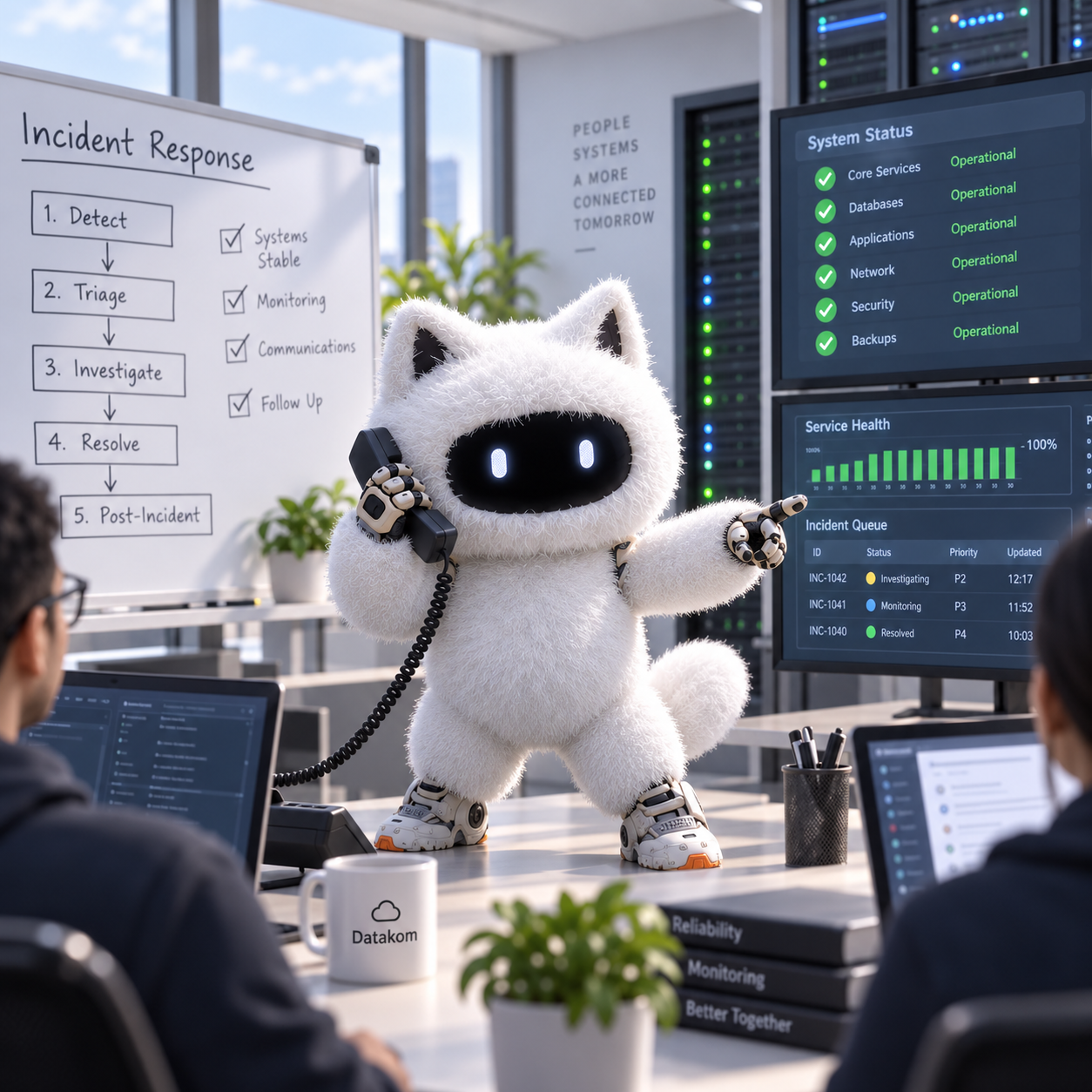
The teams that recover fastest aren’t improvising. They already know who leads, how they communicate and what happens next.
Businesses face disruptions in the same way. Sudden, high-pressure and almost never at a convenient time.
An outage, cyberattack or unexpected system failure can expose gaps that are easy to miss when everything is running smoothly. In many cases, those gaps come down to a few common mistakes that can turn a manageable recovery into a much longer disruption.
Mistake #1: Assuming backups are enough
Backups are only one part of recovery. They help you get your data back, but they don’t explain what happens next.
Your team still needs to know which systems should be restored first, who’s responsible for each step and how long the process is expected to take. Without that plan, even a usable backup can leave the business waiting longer than it should because key decisions end up being made during the outage instead of before it.
Recommendation: Create a simple recovery plan that shows what needs to be restored, in what order and by whom.
Mistake #2: Not testing the recovery plan
A recovery plan that’s never been tested is a gamble. It may work or it may fall apart the moment your team needs to follow it.
Testing helps you discover the gaps while there’s still time to fix them. Testing may reveal a backup that won’t restore cleanly, an outdated recovery step or a system that takes too long to bring back online.
Recommendation: Run the plan at least once a year, before you’re backed into a corner. Treat any surprise as something to fix, not something to explain away.
Mistake #3: Not defining roles and responsibilities
When a disruption hits, someone has to make decisions fast. What should be prioritized? Who needs to be notified? What happens next?
If those responsibilities aren’t clear, the team loses valuable time figuring out who’s in charge instead of fixing the problem.
Recommendation: Assign roles before an incident. Make sure each person knows what they own, who they coordinate with and when to escalate.
Mistake #4: Forgetting about communication
A recovery plan should account for people, not just systems. During a disruption, employees need to know what to do, customers need to know what to expect and vendors may need to adjust on their end.
If normal communication tools are unavailable, confusion can spread quickly.
Recommendation: Create a communication plan for employees, customers and vendors. Include backup channels and assign someone to own the updates.
Mistake #5: Treating recovery planning as a one-time task
A recovery plan can quickly become outdated. Employees leave, systems change and priorities shift. It goes without saying that the plan doesn’t update itself.
If the plan depends on old contacts, retired systems or outdated steps, it may slow recovery instead of helping it.
Recommendation: Set a regular schedule to review and update your recovery plan. Revisit it whenever there are major changes to your team, systems, vendors or business priorities.

Recovery favors the prepared
A tested plan, clear ownership and a reliable way to communicate can help prevent a disruption from turning into a crisis.
By addressing these common mistakes now, you can reduce uncertainty, minimize downtime and recover with greater confidence.
Recovery planning isn’t just about having the right technology. It’s also about having the right strategy. We help businesses identify gaps, strengthen recovery plans and build preparedness strategies that keep operations moving when the unexpected happens.
If you are unsure how well your organization would cope with an unexpected disruption, Datakom can help assess your current preparedness, identify critical gaps and define practical steps to strengthen your IT resilience and business continuity.
Contact Datakom to find out how prepared your business is to keep operating when the unexpected happens.
developments and industry insights


subscribe to our newsletter
Stay informed about our latest developments and industry insights.
Professional IT services and infrastructure solutions for businesses. We provide reliable technology support and managed services.
SIA Datakom
Reģ. nr. 40103142605
PVN reģ. nr. LV40103142605
Maldugunu iela 2, Marupes novads, Marupe, LV-2167, LV 40103142605
AS Luminor Bank Latvian branch, RIKOLV2X LV69RIKO0000080227272
Datakom products
Infrastructure Solutions
Cybersecurity Solutions
Datakom AI Solutions













© 2026 DATAKOM. Professional IT services.
All rights reserved.