Worry Free IT
We manage your daily IT operations so your team stops firefighting issues.
Security Pro
24/7 endpoint protection that blocks advanced threats before they strike.
Security Operation Center (SOC)
Detect and stop threats before they turn into a business crisis
Tiki-Taka PAY
Process transactions instantly with a secure, glitch-free gateway.
HITSM platform
Centralize all your IT assets, tickets, and vendors in one single dashboard.
AI Engineers
Deploy expert engineering squads to scope, build, and ship your AI projects.
Infrastructure Solutions
Cybersecurity Solutions
AI Solutions

Worry Free IT: Security Pro
We manage your daily IT operations so your team stops firefighting issues.
Security Operation Center (SOC)
Detect and stop threats before they turn into a business crisis
Tiki-Taka PAY
Process transactions instantly with a secure, glitch-free gateway.
AI Engineers
Deploy expert engineering squads to scope, build, and ship your AI projects.
Infrastructure Solutions
Cybersecurity Solutions
AI Solutions

Worry Free IT
We manage your daily IT operations so your team stops firefighting issues.
Security Pro
24/7 endpoint protection that blocks advanced threats before they strike.
Security Operation Center (SOC)
Detect and stop threats before they turn into a business crisis
Tiki-Taka PAY
Process transactions instantly with a secure, glitch-free gateway.
AI Engineers
Deploy expert engineering squads to scope, build, and ship your AI projects.
Infrastructure Solutions
Cybersecurity Solutions
AI Solutions

We don’t wait. We explore, experiment, and introduce new products and technologies early — so you get ahead, not catch up.
6 Things Every Response Plan Should Cover
IT incidents rarely happen at a convenient time. A critical system becomes unavailable, employees lose access to essential data, suspicious activity is detected, or an important business service suddenly stops working.
When that happens, solving the technical issue is only part of the challenge. It is just as important to know who makes the decisions, who needs to be informed, what should be restored first and how your team will communicate if the usual channels are unavailable.
That is why every organization needs a clear IT incident response plan.
A good plan cannot predict every possible scenario. Its purpose is to make sure your team does not have to figure everything out from scratch when time and information are limited.
Unclear responsibilities can significantly slow down the response to an incident.
If no one knows who is coordinating the response, making business decisions or communicating with employees and partners, several people may start working on the same issue while other critical tasks are overlooked.
Your incident response plan should clearly define:
It is important to define not only who does what, but also who has the authority to make the necessary decisions.
During an incident, the usual multi-step approval process may simply be too slow.
During an incident, valuable time should not be spent searching for the right phone number or trying to work out who to contact at a key supplier.
The response plan, or an accompanying emergency contact list, should include:
This information also needs to be reviewed regularly. Employees change, suppliers change and responsibilities move between people.
It is equally important to consider where the contact information is stored.

If the emergency contact list is only available through company email or another system that becomes unavailable during the incident, even a well-prepared list may be of little use.
Communication is one of the most easily overlooked parts of incident response.
In day-to-day operations, businesses rely heavily on email, Microsoft Teams and other collaboration platforms. During an incident, however, those may be exactly the systems that are unavailable.
The response plan should therefore answer practical questions such as:
A defined communication process helps prevent a technical incident from quickly becoming a communication problem as well.
It is also important to avoid making premature statements while the cause and full impact of the incident are still being investigated.

During an incident, it may not be possible to restore everything at once.
That is why the business should know in advance which systems and processes are most important for keeping operations running.
Priority should not be determined only by how technically important a system appears. The more useful question is:
For one organization, the most critical system may be warehouse management. For another, it could be a customer service platform, financial system or production environment.
The response plan should identify:
Without clear priorities, teams may try to restore everything at the same time. This spreads resources too thin and can delay the recovery of the services the business needs most.
An incident response plan does not need to be a hundreds-page technical manual.
It does, however, need to be specific enough for people to know what to do next.
At a high level, the incident response process can be viewed as a sequence of steps:
First, the organization needs to understand what has happened and what the potential impact may be. The incident then needs to be contained, recovery priorities established and systems brought back into operation in a controlled manner.
This is particularly important during cybersecurity incidents.
Restoring a system too quickly, before the root cause of the incident is understood, can result in restoring the original problem along with it.
The response plan should therefore define:
Creating the incident response plan is not the end of the process.
Employees, systems, infrastructure, suppliers and business processes all change over time. A plan that accurately reflected the business two years ago may no longer reflect how the organization operates today.
The plan should therefore be reviewed regularly and tested in practice.
This can include:
Testing often reveals weaknesses that are difficult to spot on paper.
It is far better to discover during a controlled exercise that a contact is outdated or a recovery procedure does not work as expected than to find out when business operations have already been disrupted.
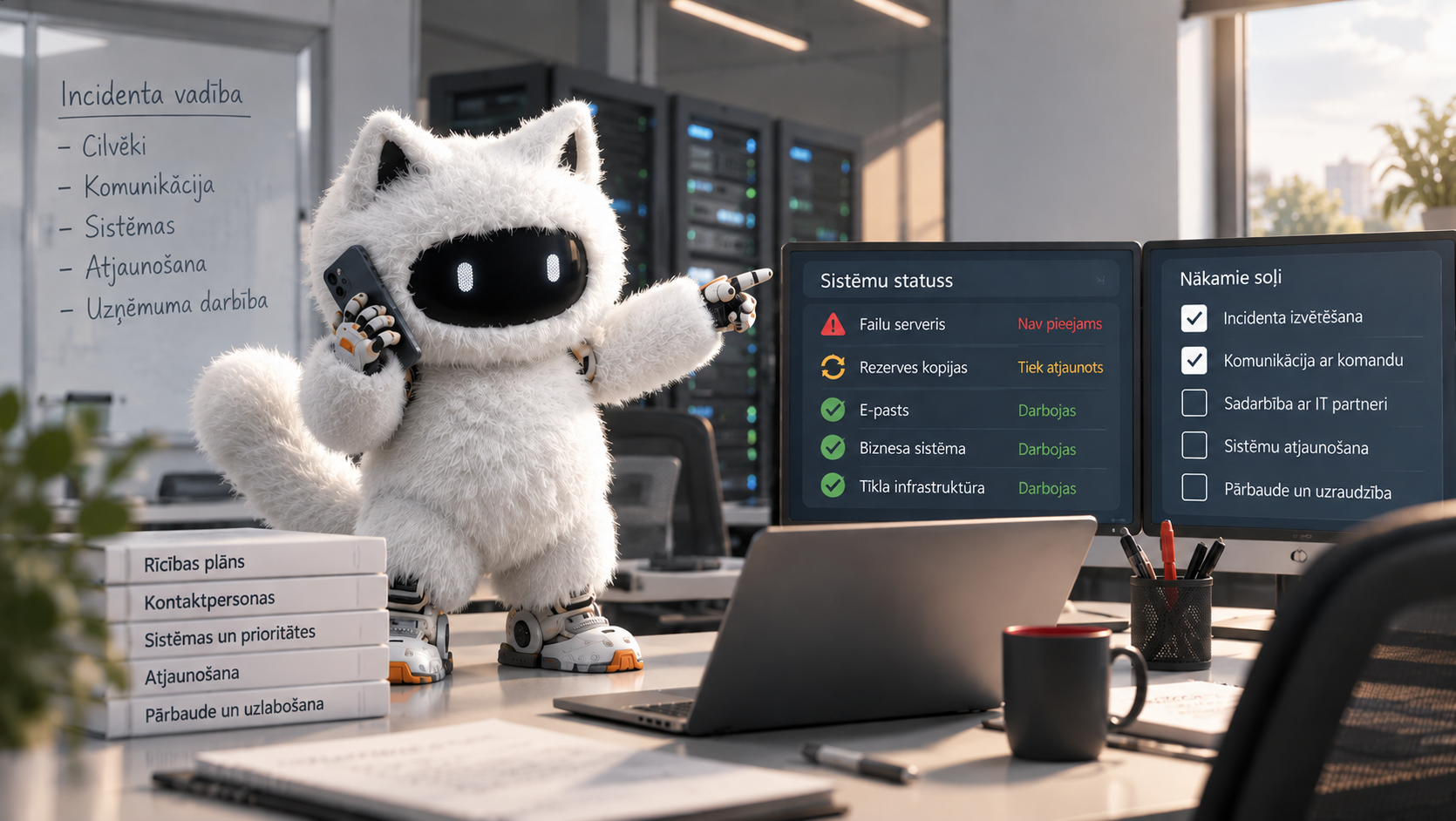
An incident response plan should not simply be a document stored somewhere in the company’s internal systems.

The people who will need to make decisions or carry out specific tasks during an incident should know the plan exists, understand their responsibilities and be prepared to act.
The more that is decided and tested in advance, the less needs to be improvised once an incident is already underway.
Incident readiness starts before the incident
A good incident response plan is not about trying to predict every possible scenario.
Its purpose is to make sure that, when something does happen, the organization already knows:
who makes the decisions, what needs to happen first, how communication will continue and how the systems and processes that matter most to guarantee the business will be restored as quickly as possible.
If you are unsure how well your organization would respond to an IT incident, Datakom can help assess your current readiness, identify the most important gaps and define practical steps to improve your IT resilience.
Contact Datakom to find out how prepared your IT environment is for the unexpected.
developments and industry insights
Stay informed about our latest developments and industry insights.

Professional IT services and infrastructure solutions for businesses. We provide reliable technology support and managed services.
Datakom products
Infrastructure Solutions
Cybersecurity Solutions
Datakom AI Solutions
© 2026 DATAKOM. Professional IT services.
All rights reserved.