
- Datakom solutions

Worry Free IT
We manage your daily IT operations so your team stops firefighting issues.
Security Pro
24/7 endpoint protection that blocks advanced threats before they strike.
Security Operation Center (SOC)
Detect and stop threats before they turn into a business crisis
Tiki-Taka PAY
Process transactions instantly with a secure, glitch-free gateway.
HITSM platform
Centralize all your IT assets, tickets, and vendors in one single dashboard.
AI Engineers
Deploy expert engineering squads to scope, build, and ship your AI projects.
Infrastructure Solutions
Cybersecurity Solutions
AI Solutions
Worry Free IT: Security Pro
We manage your daily IT operations so your team stops firefighting issues.
Security Operation Center (SOC)
Detect and stop threats before they turn into a business crisis
Tiki-Taka PAY
Process transactions instantly with a secure, glitch-free gateway.
AI Engineers
Deploy expert engineering squads to scope, build, and ship your AI projects.
Infrastructure Solutions
Cybersecurity Solutions
AI Solutions
Worry Free IT
We manage your daily IT operations so your team stops firefighting issues.
Security Pro
24/7 endpoint protection that blocks advanced threats before they strike.
Security Operation Center (SOC)
Detect and stop threats before they turn into a business crisis
Tiki-Taka PAY
Process transactions instantly with a secure, glitch-free gateway.
AI Engineers
Deploy expert engineering squads to scope, build, and ship your AI projects.
Infrastructure Solutions
Cybersecurity Solutions
AI Solutions
- Partner solutions
- About us
- About Datakom
We don’t wait. We explore, experiment, and introduce new products and technologies early — so you get ahead, not catch up.
- Contact sales
- For clients





















There are 8 billion people in the world, but 18 billion connected IoT devices. Each of them can be a potential door for an ATTACKER.
In many companies, IT readiness is judged by feeling: email works, internet is available, systems mostly run, and users somehow manage. From the outside, this may look good enough. But in Datakom’s daily work, we see a different picture. The current SOC service offerings in the market also show again and again that the understanding of SOC varies widely.
A typical situation in Baltic companies in 2025 looks like this:
- Only XDR is used. Data collection is limited, and visibility stops at endpoints. What happens in the network, cloud, or identity layer remains invisible.
- There is no SIEM and no event correlation. Each alert is reviewed separately. An attack that appears as ten “normal” events across different systems is not recognized as one coordinated threat.
- Detection is weak. Without the MITRE ATT&CK framework, UEBA analysis, and AI support, many modern attack methods remain unnoticed because they do not match the “classic” alert model.
- There is no automation. When an alert appears, every step is handled by a person. At night, on weekends, and during holidays, response time stays the same.
- The SOC is only partial, not 24/7. Attackers know this. Many ransomware attacks are activated on Friday evenings and before holidays for this exact reason.
- There is no NIS2 compliance, SLA, or KPI. This means the company cannot prove to regulators, management, or clients that security is being actively managed.
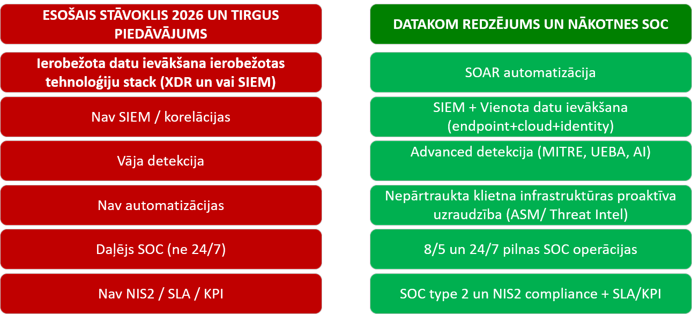
This is not just theory. It is what we see in practice, and it reflects the approach of many players in the Baltic market, with some exceptions. It means one thing: the systems “work”, but the company is not protected.
IBM’s 2025 study, which covers more than 600 organizations, confirms this with numbers: on average, a company detects a security breach after 158 days. In almost five months, an attacker can move freely through systems, collect data, and prepare the next step, while the IT team believes everything is fine.
Worry-free IT maintenance: the security foundation that is often forgotten
When people talk about cybersecurity, attention usually goes straight to technology: EDR, SIEM, XDR, firewalls. But there is a basic principle that is often ignored: a properly maintained and configured IT environment is less vulnerable.
This is where ITSM, or IT service management, comes in. It is not just a bureaucratic process. It is the first line of defense for security.
This means systems have up-to-date updates, access rights are correctly configured, and infrastructure is documented. Such an environment creates a smaller attack surface from the start.
Attackers look for the easiest paths: unpatched vulnerabilities, forgotten user accounts with too many permissions, and systems that the IT team has “forgotten” about.
The ENISA 2025 European threat landscape report confirms this. Attackers start actively exploiting new vulnerabilities within days after public disclosure, often even before the vendor has prepared a fix. In an organization where software updates are not a structured process, this window stays open for weeks.
Within the worry-free service, the most important security components are:
- Change management
Every infrastructure change is documented, assessed, and approved. Unauthorized changes are one of the earliest indicators of an attack. - Asset management
You cannot protect what you do not know you own. Unlisted devices and systems are blind spots. - Access management
Accounts left active after employees leave, excessive administrator rights, and shared passwords are not only technical issues. They are process issues. - Incident management
A structured process ensures that incidents are recorded, analyzed, and used to improve protection instead of being forgotten after the immediate problem is solved.
SOC and ITSM are not competing solutions. They depend on each other.
SOC shows what is happening in real time. Worry-free IT maintenance ensures that the environment being monitored by the SOC is properly managed and documented. Without this connection, a SOC analyst cannot quickly understand whether a specific system change is authorized or a sign of an attack.
SOC is not a product. It is a process and a set of technologies!
A simplified understanding dominates the market: “we will install SIEM” or “we will buy EDR/XDR”, and then SOC is ready. This may be the most dangerous misconception we see among potential clients.
SIEM and XDR provide visibility. They are not SOC.
SIEM collects and correlates events. XDR protects endpoints and detects threats. They are necessary, but they are not enough.
By itself, SIEM is only a log system with search functions. XDR without context generates alerts that no one processes.
A real SOC is a combination of processes, people, and technologies working together. It answers the question: do we understand what is happening in our environment right now, and can we respond tonight, at this exact moment?
Modern attacks test exactly that.
More than 80% of phishing campaigns in Europe now use AI-generated content. These attacks are more accurate, more personalized, and harder to recognize than ever before.
Supply chain attacks remain unnoticed for an average of 267 days.
Ransomware operators intentionally activate attacks at night and before holidays because they know most organizations do not have active monitoring during those times.
Against these cyber threats, it is not enough to have technology that was installed two years ago and has not been touched or improved since. An active process is needed.
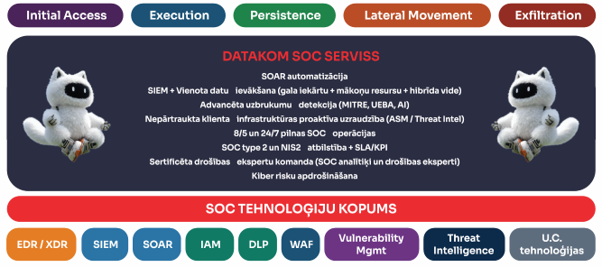
Datakom SOC is built around eight functional pillars. Together, they cover the full attack lifecycle, from Initial Access to Exfiltration, based on the MITRE ATT&CK framework. If one pillar is missing, it creates a blind spot that attackers can use.
- EDR / XDR — endpoint and extended detection
This is the foundation. Palo Alto Cortex XDR combines endpoint, network, and identity telemetry in one analysis platform.
This is Datakom’s existing operational base. The role of the other seven pillars is to expand and strengthen it. - SIEM — unified data collection and correlation
Microsoft Sentinel or Elastic SIEM collects events from all sources: endpoints, cloud, identity, network, and OT.
Correlation helps detect attack patterns that separate systems would not see on their own. Without SIEM, XDR sees only part of the picture. - SOAR — automated response
Playbook-based automation ensures that critical actions, such as isolating a device, blocking an account, or escalating an incident, happen in seconds, not minutes or hours.
SOAR is the difference between “we noticed it” and “we contained it”. - IAM — identity and access management
Most attacks use compromised identities, not technical vulnerabilities.
The IAM pillar ensures that SOC can see every authentication attempt, privilege escalation, and unusual access pattern, and can respond before damage is done. - DLP — data loss prevention
The final stage of an attack is data exfiltration.
DLP monitors the movement of sensitive data to external locations, cloud services, and removable storage devices.
Without DLP, SOC may detect an attack but not understand what the attacker has already taken. - WAF — web application protection
Public applications are one of the most common initial access vectors.
The WAF pillar protects web applications and APIs in real time, blocks OWASP Top 10 attacks, and provides visibility into who is accessing public services. - Vulnerability management — proactive risk reduction
SOC responds to what has happened. Vulnerability management helps prevent it from happening.
Regular scanning, CVSS-based prioritization, and patch management recommendations reduce the attack surface before attackers find it.
Remember: ENISA data shows that vulnerabilities are exploited within days after public disclosure. - Threat Intelligence — context that makes everything else more effective
Threat intelligence from sources such as Unit 42, MISP, and CERT.LV helps SOC understand what is happening in the Baltics and globally.
It shows which attackers are active, what methods they use, and which industries are being targeted.
Without context, an alert is only noise. With context, it becomes a signal for action.
Together, these eight pillars form what Datakom calls a complete SOC. It is not a technology installation. It is a live defense process that operates continuously and develops together with the threat landscape.
We need to ask ourselves:
- Do we know which systems are critical, and are they up to date?
- Do we have a documented IT environment and change history?
- Do we know who has access to which systems today, at this moment?
- How many days pass before we notice unusual activity in our networks?
- If a data leak happened today, would we discover it ourselves, or would we hear about it from a third party?
- Do we have a plan for what to do in the first 72 hours after an incident?
- Does our security management meet NIS2 requirements?
The answers to these questions show not only the company’s current IT readiness, but also how seriously it treats its risks and its responsibility toward clients, partners, and regulators.
IT readiness is not a fixed state. It is a process, just like SOC and ITSM.
That process either happens consciously, with structure and clear goals, or it does not happen at all.
Autors:
Artūrs Filatovs
Drošības risinājumu produktu vadītājs
developments and industry insights

subscribe to our newsletter
Stay informed about our latest developments and industry insights.
Professional IT services and infrastructure solutions for businesses. We provide reliable technology support and managed services.
SIA Datakom
Reģ. nr. 40103142605
PVN reģ. nr. LV40103142605
Maldugunu iela 2, Marupes novads, Marupe, LV-2167, LV 40103142605
AS Luminor Bank Latvian branch, RIKOLV2X LV69RIKO0000080227272
Datakom products
Infrastructure Solutions
Cybersecurity Solutions
Datakom AI Solutions













© 2026 DATAKOM. Professional IT services.
All rights reserved.